
A practical decision path for Incubator Heating Element, starting with trade-off framing for technical review
Choosing an incubator heating element is not only a component comparison. It is a system decision involving the cabinet, fan, sensors, controller, humidity system, tray arrangement, and intended operating conditions. Project managers should first define the equipment and incubation requirements, then test each candidate against those requirements rather than treating a listed specification as proof of suitability.

Clarify the decision to be made
Start with the use case. Record the egg species, incubation stage, cabinet design, tray layout, expected loading condition, and required temperature and humidity conditions. These inputs matter because the heater operates as part of a controlled cabinet, not as an isolated heat source. A heating element that fits the enclosure may still require a different airflow arrangement, sensor position, or protection component.
The first trade-off is therefore architectural: should the project use a standalone heater with an existing fan system, or a fan-assisted module? The appropriate path depends on the equipment already in place and on how air must move through the cabinet. Review the return-air path, sensor positions, moisture conditions, and available mounting space before comparing heater structures. This prevents the review from narrowing too early to voltage, wattage, or physical size.
Build a concise comparison framework
A useful review separates stated evidence from project assumptions. For each candidate, create four fields: electrical and dimensional data, airflow integration, control relationship, and installation requirements. Keep a separate note for every item that still depends on the cabinet design or operating condition.
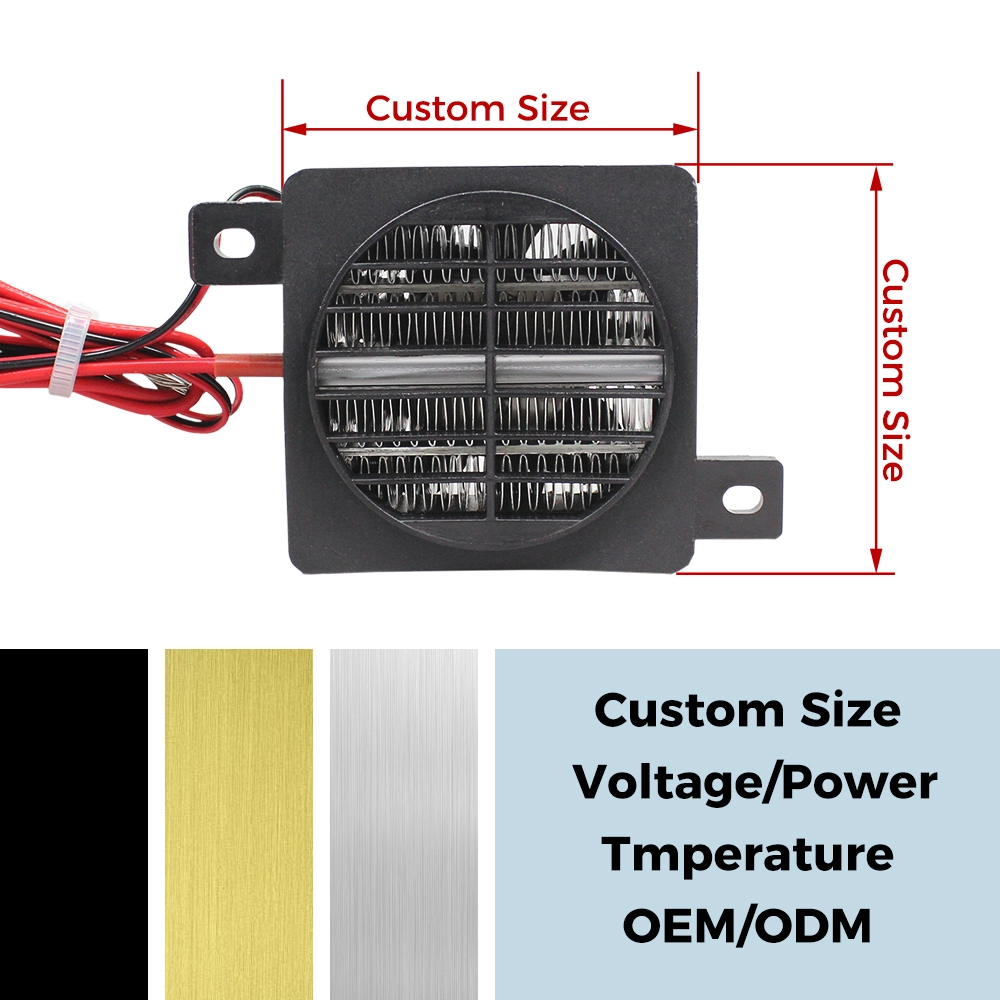
The captured application page lists one conductive PTC air heater at 220V, 100W, and 92 × 31 × 25 mm. It also states that suitable electrical insulation and housing are required. Those details can support an initial fit review, but they should not be generalized to every heater or every incubator configuration. Treat them as page-listed data for the stated product scope.
| Review dimension | What the evidence states | Project question |
|---|---|---|
| Electrical and physical fit | One listed conductive PTC air heater is 220V, 100W, and 92 × 31 × 25 mm. | Does the intended cabinet provide the required electrical interface, space, insulation, and housing? |
| Heat generation and control | PTC ceramic resistance rises as the element warms, helping limit power output; the cabinet controller determines when heating is required. | How will the heater connect with the existing controller and temperature-sensing arrangement? |
| Airflow integration | The heater may be standalone for an existing fan system or part of a fan-assisted module. | Which arrangement matches the fan, return-air path, tray layout, and sensor positions? |
Use this framework to expose trade-offs without inventing a ranking. A compact heater may simplify space planning, while a fan-assisted arrangement may change integration requirements. The available evidence does not establish a universal best option. The project team must connect the component choice to the cabinet design and the intended operating conditions.
Use the variation keyword as an application test
When a team searches for an incubator heat element, the useful question is not simply whether the part produces heat. The question is how heat reaches the working volume and how the control system responds. Electrical current heats the PTC ceramic element, its resistance rises as it warms, and the cabinet controller still determines when heating is required. This distinction keeps the element’s stated behavior separate from the complete cabinet’s control performance.
One concrete application point comes from the official incubation temperature-control page: tray arrangement, fan performance, and the return-air path affect temperature distribution. It advises avoiding concentrated hot air directed onto the eggs and checking temperatures at multiple tray positions under the intended loading and operating conditions. This is a bounded design check, not evidence of performance for every heater or cabinet.
| Review dimension | What the evidence states | Project question |
|---|---|---|
| Electrical and physical fit | One listed conductive PTC air heater is 220V, 100W, and 92 × 31 × 25 mm. | Does the intended cabinet provide the required electrical interface, space, insulation, and housing? |
| Heat generation and control | PTC ceramic resistance rises as the element warms, helping limit power output; the cabinet controller determines when heating is required. | How will the heater connect with the existing controller and temperature-sensing arrangement? |
| Airflow integration | The heater may be standalone for an existing fan system or part of a fan-assisted module. | Which arrangement matches the fan, return-air path, tray layout, and sensor positions? |
That check also changes how a technical review should define success. Do not assess only whether the heater reaches a nominal temperature near its mounting point. Examine whether the proposed airflow path supports the cabinet’s tray arrangement and whether sensor locations represent the conditions that matter. If the design changes, repeat the review rather than carrying forward an assumption from a different layout.
Avoid unsupported conclusions
Several common conclusions should be kept out of an evidence-led comparison. A listed wattage does not, by itself, establish uniform temperature distribution, heating speed, energy use, or suitability for a particular cabinet. A PTC resistance behavior does not replace the controller, sensors, fan, or humidity system. A physical dimension does not confirm that the required housing, insulation, clearances, or mounting method are available.
Use careful language in the decision record. Mark each statement as page-listed, project requirement, or open integration question. For example, “220V and 100W are listed for the cited heater” is a supported observation. “This rating will maintain the required cabinet temperature” is a project conclusion that the available evidence does not establish. This distinction helps procurement and engineering teams avoid turning a component description into an unsupported promise.
Carry the requirements into procurement
The procurement brief should carry the complete decision context. Include the cabinet dimensions, tray arrangement, fan configuration, return-air path, sensor positions, moisture conditions, controller interface, electrical requirements, insulation and housing needs, and intended loading conditions. Ask suppliers to respond against those defined inputs rather than sending only a generic request for a heater.
Finally, preserve the comparison as a decision record. State which facts came from the cited application page, which requirements came from the project, and which interfaces remain subject to design review. That approach keeps trade-offs visible and gives PTCYIDU a precise technical context if the team proceeds to discuss a heater configuration, without treating a page-listed detail as a complete system recommendation.